Does MBY provide wind and CFD consulting in Türkiye?
Yes. MBY is headquartered at İTÜ ARI Teknokent in Istanbul. We provide CFD analysis, wind load calculations, pedestrian wind comfort assessments and wind tunnel testing for projects in Türkiye and abroad. On our façade projects in Türkiye, wind is part of the design: at the Presidential National Library in Ankara, the wind, seismic and thermal actions affecting the building envelope were assessed in detail. For projects in Türkiye, write to info@mby-e.com or use our contact form.
When is CFD used, and when is wind tunnel testing needed?
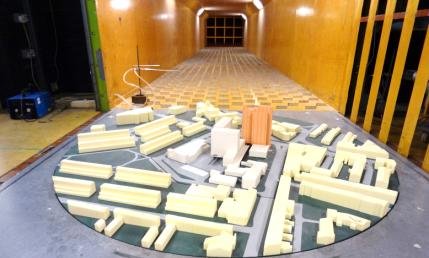
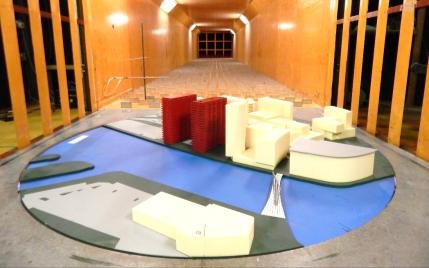
The method depends on the project objectives, the design stage and the required level of accuracy. For simple geometries, wind loads can be calculated with codes such as EN 1991-1-4 or ASCE 7. CFD comes into its own where the building geometry, neighbouring structures or topography cannot be adequately represented by code tables, and where pedestrian comfort needs to be examined across the entire site. Wind tunnel testing may be needed for buildings that are tall or slender, whose dynamic behaviour matters, or that are strongly affected by their surroundings; effects such as crosswind vibration and torsion cannot always be adequately represented by the static equivalent loads in the codes.
How is pedestrian wind comfort assessed?
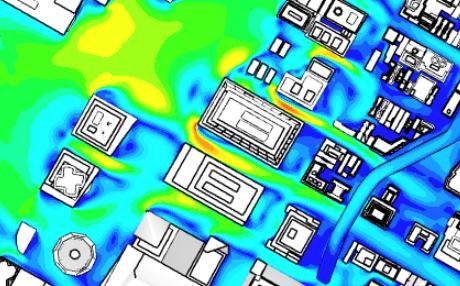
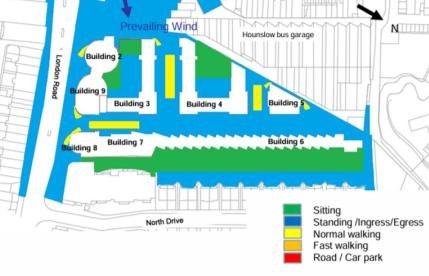
Wind conditions around buildings, plazas, terraces and public spaces are benchmarked against recognized comfort criteria according to how each space is used: the targets for sitting, standing, strolling and business walking differ. High wind speeds that could unbalance a person are checked separately against safety criteria. At Hudson Yards in New York, MBY ran transient CFD simulations for 16 wind directions, taking into account local topography, surrounding buildings and meteorological data, and assessed pedestrian-level wind against the Lawson 2001 criteria.
How are façade wind loads determined?
Wind pressure is not distributed evenly across a façade: higher suctions can develop at corners, upper floors, set-back surfaces and roof edges. Cladding pressures, overall structural loading and local peak effects are therefore determined separately; glass thickness, profile sizes and anchor spacing depend directly on these loads. Where a site has its own particular conditions, a site-specific study is carried out: for Maxx Royal in the Maldives, MBY established the basic wind velocity from the exposure conditions of the North Malé Atoll, and the façade design was based on these parameters.
At what stage should a wind engineer be involved?
As early as possible. At the early design stage, a desk-based assessment using local wind climate data, published guidance and experience from comparable sites provides rapid screening. As the design develops, alternative building orientations, massing arrangements, canopies, wind screens and landscape measures can be compared using CFD. Whatever stage your project is at, we can choose the right method together.